The Continuing Argument Over Fiscal Policy

01/31/11 Tampa, Florida – I note that a Bloomberg.com article reported that Jean-Claude Trichet – whom I refer to as “socialist moron Keynesian euro-trash halfwit,” but which everyone else refers to as European Central Bank President – is said to have said, while “speaking on behalf of the world’s central bankers,” that “the global economy has recovered better than expected, boosting inflation pressures in emerging markets.” Hahaha!
What Mr. Trichet literally said is that, “It’s clear that it is extremely important that we all keep control of inflation expectations, and that calls for appropriate decisions,” which is actually a relief, because I hate it when something is extremely important, yet not in control, like when my wife is so mad at me about something that is, apparently, extremely important, yet her anger is so uncontrolled in that she is stammering in rage “You…you…you…!”
And if I try to help her by asking, “What in the hell are you stammering about, now?” oddly enough, she gets worse! And her eyes kind of bug out, too! I mean, I can’t win here!
You can see the kind of crap that I have to put up with all the time!
And it doesn’t get any better with this Trichet character, either, as he says that it is clear, and that it is extremely important, to “keep control of inflation expectations” which, in this case, is apparently achieved by saying lying, stupid things like how the economy has recovered “better than expected,” which is only true if you expected the world to erupt in anarchist flames where everything gets destroyed in a hyperinflationary catastrophic bankruptcy that sweeps around the world while flying saucers invade the Earth and enslave us all, or Democrats invade the Earth and enslave us all, one’s as bad as the other, probably.
And so, explains Mr. Trichet, the “recovery,” which is better than expected, is why price inflation is up! Hahaha!
And the lie of a recovering economy makes it suddenly OK that the poor, and everyone else, for that matter, slip a little closer to starvation because rising prices for food and energy consumes all their income?
What kind of crazy, demonic government is that? The same kind as America has, that’s what kind! Hahaha!
And that – that! – is why I am a proud Tea Party member who wishes us the best, and who laments the fact that it is Far, Far Too Late (FFTL) to do anything, like a car going 90 miles an hour sailing off a cliff after careening crazily down a perilous and steep mountain road.
As the car sails though the air, two guys inside are arguing, one saying, “More spending!” and the other saying, “Less taxes!”
Now, there are those that do not understand that such examples of Real Mogambo Humor (RMH) are very, very subtle, and thus not suited to the masses, who do not see the glaring, obvious connection between comparative economic virtues of more spending or less taxes and the prospect of a speeding car going over a cliff and smashing onto the rocks below, everyone inside screaming in fear all the way down, until the sudden stop kills everyone in a horrible, gruesome death milliseconds before the car bursts into flames, destroying everything, including whatever the car landed upon, probably an endangered species of some kind, or somebody’s mailbox, which aren’t cheap.
And when people gather around to see what happened, they will ask, “What happened?” If they did, then I would tell them that two guys in the car went over a cliff because they were arguing about fiscal policy when they should have been, instead, in total agreement to complain about the Federal Reserve creating so freakishly much money!”
If I did, I am sure that they would look at me with those same blank looks of incomprehension and befuddled stupefaction that are on the faces of the people in the security video that shows I am peacefully standing in line, waiting for a cashier, and I am exercising my First Amendment rights by passing the time saying to the cashiers as I waited, “Take your time, morons! The longer you wait to ring up my sale, the utility of my purchase is still new and undiminished, even as my money becomes more worthless, losing purchasing value with every tick of the clock – tick tock, tick tock, tick tock! – because the foul Federal Reserve is creating $100 billion of new money Per Freaking Month (PFM)!”
I expected, as I always expect, someone to say, “Well said! Well said, handsome, intelligent stranger to whom the bewildering world of economics seems but children’s toys!”
Well, they didn’t. So you can see on the video where I tell them, “The Federal Reserve is creating money out of thin air so that the corrupt government can borrow the money and spend it, which increases the money supply, which distorts everything, leading to weird bubbles and busts, mostly busts, fads and flops, mostly flops, and inflation, inflation, inflation that is going to eat you alive!”
This is when the security video shows the security guard coming over and asking me to leave, which I do, but not before saying, in my most melodramatic Mogambo eloquence and with a theatrical dismissive wave of my arm, “You have been warned, earthlings!”
It’s too bad that the video does not have a sound track, and thus there is no official record of my voice trailing off into the distance, saying, “So buy gold and silver, you morons! Gold and silver!”
I hope I did some good!

China’s Urban Underground Dwellers
China’s Urban Underground Dwellers
01/31/11 Stockholm, Sweden – In a city of about 20 million, it’s no surprise Beijing has more than its fair share of housing challenges. However, a solution that’s become common for many average wage earners is not one you would probably guess they’d consider first… living underground in a 30-square mile network of air defense basements. The bunkers were originally built as shelter to protect citizens in the event of foreign air raids, and the Telegraph estimates that “as many as a million people live in small, windowless rooms that rent for £30 to £50 a month.” For the time being, despite China’s rising wealth, the homes are some of the only affordable housing options available to Beijing’s migrant laborers.
According to the Telegraph:
“In a Beijing suburb, beneath one of the thousands of faceless residential tower blocks that have carpeted the city’s peripheries in a decade-long building frenzy, one of Beijing’s ‘bomb shelter hoteliers’, as they are known, agrees to show us his wares. Passing under a green sign proclaiming ‘Air Defence Basement’, Mr Zhao leads us down two flights of stairs to the network of corridors and rooms that were designed to offer sanctuary in the event of war or disaster.
“‘We have two sizes of room,’ he says, stepping past heaps of clutter belonging to residents, most of whom work in the nearby cloth wholesale market. ‘The small ones [6ft by 9ft] are 300 yuan [£30] the big ones [15ft by 6ft] are 500 yuan.’
“Beijing is estimated to have 30 square miles of tunnels and basements, some constructed after the Sino-Soviet split of 1969, when Mao’s China feared a Soviet missile strike, and many more constructed since to act as more modern emergency refuges. [...] ‘Some 80pc of our tenants are girls working in the wholesale market and the rest are peddlers selling vegetables or running sidewalk snack booths,’ he adds. ‘There are dozens of similar air defence basement projects in residential communities. In this area, they say 100,000 live underground.’”
Time will tell whether or not there is a bubble in China real estate. On the one hand, there are fewer mortgages in China than in the US, and therefore less of that type of home ownership speculation. On the other hand, the article points out that a very basic small apartment, about 860 square feet, now costs over 2,000,000 yuan, while the typical monthly salary is about 4,000 yuan. This means, “the average person would take 50 years to buy such an apartment, assuming they saved every penny they earned.” You can read more details, and arrive at your own conclusion, by visiting the Telegraph’s coverage of the underground world that hints at China’s coming crisis.
The Meddling of Global “Thinkers”
The Meddling of Global “Thinkers”

01/31/11 Baltimore, Maryland – Now here’s something interesting. Every year, Foreign Policy magazine produces a list of the Top 100 Global Thinkers in the World. We picked up the list…looking for our own name.
But wait…
The key is that these are “global” thinkers. They’re not just thinkers, in other words, they are people who are thinking about how people on the other side of the planet should conduct their business.
We were suspicious even before we looked at the list. “Foreign Policy”? We’re against it. Why should we worry about things that don’t concern us?
“Well… You can’t put your head in the sand,” you might reply. “You have to be concerned, because things that happen overseas do affect you.”
Yes, that is true. They affect us. But so does the price of whiskey, the traffic on the Beltway, and the weather. None of them is worth thinking about. We can do nothing about them. And it would be indecent for us to try.
Imagine if we took an interest in the whiskey distiller’s business. What could we do? Try to force him to lower his prices? Try to show him how to operate more efficiently – as if we could know? Set up a buyers’ cartel to negotiate for lower prices? At best, we’d be wasting our time. At worse, we might succeed! Then, whiskey producers would be responding not to market forces…but to meddlers’ forces. What a mess that would be!
Meddling with things close at hand is bad enough. Meddling with things far away is worse. Remember our Daily Reckoning dictum: ignorance increases by the square of the distance. The farther you get away the harder it is to tell what is going on. The details disappear. All you can make out are the rough outlines. Shadows…reflections…silhouettes… In the darkness, you step on every rake and fall into every hole.
The next thing you know, you are calling for “reforms” in countries you’ve never even visited…setting the price of China’s money…and invading Iraq.
But let’s look at who Foreign Policy magazine thinks are the 100 Top Global Thinkers.
Uh oh. In the first and second place are Warren Buffett and Bill Gates. Hmmm… They’re smart guys. But what makes them “thinkers”? What have they been thinking about? And what are their thoughts on the subject?
FP says they are there, not for their contributions to the wealth of mankind, but for their philanthropic activities. Wait a minute. What’s philanthropy got to do with thinking?
Okay… We’re stumped on that one… So, who’s the number 3 thinker? Barack Obama! Hold on… This is getting silly. Have you ever heard Barack Obama come up with an original thought? Or any kind of thought worthy of the word? No. That’s not his thing. He’s a politician. Politicians are not thinkers. They may be doers…but they’re not thinkers. Obama gives us plenty of empty expressions and hollow words – “change you can believe in”…“hope”… “winning the future” – but real thoughts? Original ideas? Nope.
Generally, politicians are not thinkers. Occasionally, you get a politician who pretends to be a thinker – such as Princeton University chief Woodrow Wilson. But he almost invariably turns out to be a jackass and a fool.
There must be exceptions – Marcus Aurelius and Thomas Jefferson come to mind. But they seem ill-suited to the political profession and probably should have eschewed public office in the first place.
So let’s keep moving. There must be someone on this list who is a real thinker.
Let’s look back at last year…let’s see…who was FP’s top thinker?
Ben Bernanke!
Well, that does it for us. What’s the matter with these people? Can’t they tell the different between tired hacks with worn-out, crackpot ideas…and real thinkers?
The Foreign Policy editors should do some real thinking of their own. Then, maybe they’d mind their own business.
The Riots In Egypt And The Price Of Oil
The Riots In Egypt And The Price Of Oil
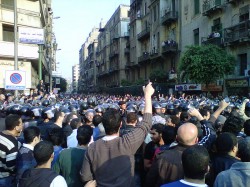 As if the world economy did not have enough problems already, now the riots in Egypt threaten to send the price of oil soaring into the stratosphere. On Friday, the price of U.S. crude soared 4 percent. A 4 percent rise in a single day is pretty staggering. The price of Brent crude in London closed just under the magic $100 a barrel mark at $99.42. The incredibly violent riots in Egypt have financial markets all over the globe on edge right now. Any time there is violence or war in the Middle East it has a dramatic impact on financial markets, but this time things seem even more serious than usual. Many believe that we could see an entirely new Egyptian government emerge out of this crisis, and the uncertainty that would bring would make investors all around the globe nervous. Financial markets like predictability, peace and security. If Egyptian President Hosni Mubarak's 30 year reign is brought to an end, it will severely shake up the entire region, and that will not be good news for the global economy.
Have you seen how violent these protests have become? Cars and buildings are on fire all over the place. Even the headquarters of Hosni Mubarak's political party was burned down. The Egyptian military has been deployed on the streets of Cairo. Protesters have been showering government forces with stones, firebombs and anything else that they can find to throw. Security forces have been using rubber bullets, water cannons and tear gas to try to disperse the protesters but those efforts seem to be doing little good. Deaths and injuries are being reported all over the place. There are even rumors that the wife and son of Hosni Mubarak have already left the country.
At this point, Mubarak has gone on national television and has announced that he has asked his cabinet to resign. That is an absolutely stunning move, but it is doubtful that the protesters will be satisfied. All over Cairo protesters continue to chant for Mubarak to resign.
The following is a short compilation of some raw video from the riots in Egypt....
These riots in Egypt come on the heels of violent uprisings in Algeria and Tunisia. In fact, it seems like virtually the entire Middle East is in a very foul mood right now. Riots have been reported in Lebanon, in Jordan and in Yemen over the past few days.
Some of the rioting has been motivated by economic factors, but unfortunately all of this rioting is only going to make the global economic situation even worse. Concern over all of these riots is driving up the price of oil and driving up the prices of agricultural commodities. These higher prices are going to make it even harder for the poor people in the Middle East to afford food.
But also it must be acknowledged that much of this rioting is being done for very deep political and religious reasons as well. Many westerners are cheering the protests in Egypt because they envision the protesters to be some sort of "freedom fighters". But the vast majority of these protesters do not desire "American-style democracy". The Muslim Brotherhood is one of the groups at the heart of these protests. The government that they intend to set up would not give "liberty and freedom for all". Rather, it would be a hardline Islamic government based on Shariah law. According to Wikipedia, the Muslim Brotherhood bills itself as the "world's most influential Islamist movement", and their goal is to impose their version of Islam on society....
The Brotherhood's stated goal is to instill the Qur'an and Sunnah as the "sole reference point for ... ordering the life of the Muslim family, individual, community ... and state"
So unless your version of "freedom" includes being forced to live like the Taliban, then you probably would not enjoy the "liberty" that the Muslim Brotherhood wishes to impose on you.
Coptic Christians all over Egypt are already being slaughtered even with a relatively pro-western president in power. On New Year's Day, an attack on a Coptic Christian church in Egypt killed 21 people. The following is how one eyewitness described the scene to a reporter from the New York Times....
“There were bodies on the streets,” said Sherif Ibrahim, who saw the blast’s aftermath. “Hands, legs, stomachs. Girls, women and men.”
Once a radical Islamic government is installed in Egypt it will be open season on all Christians.
Yes, there is a whole lot of blame to be passed around to other nations, organizations and individuals in the Middle East for things they have done as well, but that does not excuse the horrific persecution of the Coptic Christians in Egypt.
We have to call a spade a spade. We cannot condemn some forms of tyranny and persecution and then make excuses for other forms of tyranny and persecution just because those doing it are on "our side".
Replacing one form of tyranny (Mubarak) with an even more repressive form of tyranny (The Muslim Brotherhood) is not something that those who love liberty and freedom should be celebrating.
In any event, everyone should be able to agree that these events are going to severely rattle world financial markets that were already very nervous about 2011.
If these violent riots in Egypt and other countries in the Middle East keep going on, the global price of oil and the global price of food will continue to soar.
Not that oil and food were not going to be heading in that direction anyway. Yesterday I wrote about the warning signs for the global economy that we are starting to see. Wheat and corn have absolutely skyrocketed in price over the past 6 months. The UN had already been projecting that we would see a 30 percent increase in the global price of food in 2011 even before these riots.
If you add rampant political instability into the mix, there is no telling how bad food inflation could get this year.
Many experts have already been forecasting substantial food shortages throughout the world this year based on all the extreme weather we have been having. So what is going to happen if something causes those food shortages to be even worse than anticipated?
We live in very interesting times my friends. The globe is becoming an increasingly unstable place. Even nations that seemed perfectly stable just a few months ago can erupt in rioting at almost any moment.
People around the world are getting angry. Thanks to the Internet, people are able to circumvent official government propaganda more easily than ever before. This is making it harder and harder for governments to control people.
Egypt tried to regain some of that control during the riots by shutting down cell phones and by shutting down the Internet but it did not work.
Let's just hope that Egypt can soon find peace and that the changes that are made in the Egyptian government are good for freedom and liberty.
Warning Signs
Warning Signs
 Do you see all of the warning signs that are flashing all around you? These days it seems like there is more bad economic news in a single week than there used to be in an entire month. 2011 is already shaping up to be a very dark year for the world economy. The price of food is shooting through the roof and we have already seen violent food riots in countries like Egypt, Algeria and Tunisia. World financial markets are becoming increasingly unstable as the sovereign debt crisis continues to get worse. Meanwhile, the number of Americans applying for unemployment benefits is up, foreclosures are up and poverty continues to spread like a plague throughout the United States. What we are starting to see around the globe is a lot like the "stagflation" of the 1970s. All of the crazy money printing that has been going on is overheating prices for agricultural commodities and precious metals, but all of this new money is not doing much to help the average man or woman on the street.
Do you remember what the economy was like in America during the 70s? We had high unemployment and high inflation at the same time. It was horrible. Well, all the warning signs are there for a stagflation repeat. Unemployment is at epidemic levels and it isn't showing any signs of decreasing much any time soon. Meanwhile, the crazy money printing that the Federal Reserve and other central banks have been doing is starting to cause significant inflation. The price of oil is about to cross the 100 dollar a barrel mark and the UN is forecasting that the global price of food is going to increase by 30 percent by the end of the year.
So, yes, there are some really, really good reasons to be incredibly concerned about the global economy in 2011.
Meanwhile, the only solutions that our global leaders seem to be offering are more money printing, more government debt and more financial control by international organizations.
The truth is that we have a real mess on our hands. The following are 20 economic warning signs that should be of great concern to all of us....
#1 Over the past seven days, the price of wheat has risen by 11 percent as concerns about food shortages continue to grow around the world.
#2 The price of corn is up a staggering 94 percent since last June.
#3 The United Nations is projecting that the global price of food will increase by 30 percent in 2011.
#4 According to the U.S. Department of Labor, the number of Americans applying for unemployment benefits rose last week to the highest level since last October.
#5 According to the Pew Charitable Trusts, of the 14 million Americans "officially" unemployed in December, 30% of them had been unemployed for one year or longer.
#6 Beginning in the month of March, the U.S. Postal Service will begin shutting down up to 2,000 post offices across the United States.
#7 In an absolutely stunning move, Standard & Poor's has downgraded Japanese government debt from AA to AA-.
#8 72 percent of the major metropolitan areas in the United States had more foreclosures in 2010 than they did in 2009.
#9 Approximately 5 million homeowners in the United States are at least two months behind on their mortgages, and it is being projected that over a million American families will be booted out of their homes this year alone.
#10 According to the Congressional Budget Office, the Social Security system will run a deficit of 45 billion dollars this year. When the new payroll tax breaks are factored in, the projected "Social Security deficit" for this year swells to 130 billion dollars.
#11 The U.S. money supply has been rising at a pace that is absolutely unprecedented.
#12 Right now, money is flowing out of bonds at an absolutely staggering pace.
#13 The U.S. Bureau of Labor Statistics says that the price of food increased 50 percent faster than the overall rate of inflation during 2010.
#14 According to the U.S. Conference of Mayors, visits to soup kitchens are up 24 percent over the past year.
#15 During the last school year, almost half of all school children in the state of Illinois came from families that were considered to be "low-income".
#16 Those living in the town of Discovery Bay, California will soon not be permitted to use cash to pay for any public services. Could this be another disturbing step in the direction of a cashless society?
#17 French President Nicolas Sarkozy says that the IMF should be given the power to enforce new rules that would be designed to prevent "global economic imbalances" from happening.
#18 The U.S. government is currently borrowing about 40 cents of every single dollar that it spends.
#19 According to the Congressional Budget Office, the U.S. government will have the biggest budget deficit ever recorded (approximately 1.5 trillion dollars) this year.
#20 It is being projected that the U.S. national debt will increase by $150,000 per U.S. household between 2009 and 2021.
So is there any good news?
Well, yes there is.
U.S. Representative Ron Paul has introduced a new bill to audit the Federal Reserve. Let us hope that the move to audit the Fed fares better in the 112th Congress than it did in the 111th Congress. It would be wonderful if the American people could actually learn what has been going on inside the Fed all this time.
But mostly the news about the global economy is really bad. There have been some people that have been warning for decades that all of this money printing and all of this government debt would eventually catch up with us. Now we have almost reached the moment of reckoning that the doomsayers have been warning about for so long, and it is going to be really painful to go through it.
Thanks to the greatest debt bubble in the history of the world, we have been living beyond our means for decades. When "times were good" it was not because either the Republicans or the Democrats were doing something right. The truth is that both political parties have been horribly addicted to government debt. The debt-fueled prosperity that our politicians purchased for us is starting to come to an end, and an economic implosion is coming that most Americans will never see coming.
But hopefully most of the readers of this article are much wiser than the average American. The warning signs are there. Now is the time to take action and get prepared.
Shut Down The Federal Reserve
Shut Down The Federal Reserve, Break Up The Big Banks And 16 Other Ideas Barack Obama Could Have Proposed If He Actually Wanted To Fix The Economy
 How do we fix the economy? That is a question that tens of millions of Americans are asking right now. Republicans are harshly criticizing the empty economic proposals being put forward by Barack Obama and the Democrats, but the Republicans don't seem to have any real solutions either. There is talk of cutting taxes a little bit more, reducing federal spending a little bit and getting rid of a few useless federal regulations but doing any of those things would essentially be like spitting into Niagara Falls - the effect would not really be noticeable at all. As this column has documented over and over and over, the economic and financial problems that we are facing are so enormous that radical solutions are needed. In essence, what we need is not an "economic bandage" or two - what we need is major reconstructive surgery. If dramatic action is not taken, our economy is going to completely collapse.
Is anything that Barack Obama is currently proposing going to help fix the economy? No, of course not. As I wrote about the other day, Obama's address to the nation was packed with empty promises and a whole lot of inspirational nonsense. There were no real solutions to the very real problems we are facing.
So is there anything that we could do to actually start fixing things?
Yes, but the solutions are radical. They would cause quite a bit of chaos. They would not be easy for people to accept.
But the truth is that our economy and our financial system have terminal cancer. If something radical is not done quickly we are going to lose the patient.
The following are 16 ideas that Barack Obama could have proposed if he actually wanted to fix the economy....
#1 We Must Shut Down The Federal Reserve
If you are not willing to accept this, you may as well not read the rest of the solutions. The truth is that the U.S. government will never be able to solve the national debt problem until the Federal Reserve is shut down. The U.S. government should nationalize all Federal Reserve assets and start issuing currency that is completely and totally debt-free.
Under such a system, it is conceivable that U.S. budget deficits could be eliminated entirely and that over time the entire U.S. government debt could be retired.
One of the biggest threats of going to such a system would be inflation, but remember, the United States has only had a major, ongoing problem with inflation since the Federal Reserve was created back in 1913. The U.S. dollar has lost well over 95 percent of its value since the Federal Reserve was created, and so it is hard to imagine that we would do even worse without the Federal Reserve.
In any event, it is the fundamental right of any sovereign nation to be able to issue and control its own currency. This right was given to the U.S. government by the U.S. Constitution and it is time for the U.S. government to reclaim that right.
#2 We Must End Trade With All Nations That Allow Their Citizens To Be Paid Slave Labor Wages Or That Do Not Respect Basic Human Rights
This would dramatically reduce the "outsourcing" of our jobs and our industries almost overnight. The truth is that it was never a good idea to put American workers in direct competition with hundreds of millions of workers that are making slave labor wages on the other side of the globe.
Trading with nations that have a similar wage structure to ours and that respect basic human rights (Canada, for example) is a very good thing. However, all of the "free trade" agreements that politicians from both parties have been pushing down our throats for decades are literally wrecking the U.S. economy.
Since 2001, over 42,000 factories have been shut down in the United States. This proposal would go a long way towards stopping the bleeding, and if some of these countries are willing to raise their wage levels significantly then we would be able to resume trade with them in the future on a much more level playing field.
#3 We Must Radically Reduce The Size Of The Federal Government
Our big, fat government is a big, fat drain on our economy. We have millions of paper pushers that don't contribute much of anything of real value.
Not only that, but some of the things that the U.S. government wastes money on are absolutely mind blowing. There is a reason why our founders insisted that we have a very limited government. It is time to get back to those principles.
The Congressional Budget Office is projecting that the U.S. government budget deficit for this year will be nearly $1.5 trillion.
Talk about ridiculous!
I estimate that we could easily cut the size of government in half without hampering how effective it is.
We could start by abolishing the Department of Education. After that, there are several dozen other government agencies and institutions which are worthy candidates for elimination.
#4 We Must Provide Temporary Jobs For The American People During The Economic Transition
If the Federal Reserve is shut down and the size of the federal government is cut in half, it would cause quite a bit of economic chaos. During this transition it will be important to help people survive.
Instead of just passing out a bunch of handouts, a better alternative would be getting the American people working on something constructive.
During this time, the U.S. government could use all of the untapped labor of the unemployed to build massive infrastructure projects.
According to the American Society of Civil Engineers, we need to spend approximately $2.2 trillion on infrastructure repairs and upgrades just to bring our existing infrastructure up to "good condition".
So there is certainly a lot to do.
These jobs would just be temporary until new manufacturing facilities are set up and jobs in private industry are plentiful again.
Having the American people produce something of value is better than just handing them endless unemployment checks.
#5 We Must Ban All Short Selling
When you allow greedy individuals the opportunity to make lots of money by betting against the U.S. economy, it gives those individuals an incentive to make sure that those bets pay off.
Yes, this proposal is controversial, but it just makes sense. If people want to make money, it should be because a company is doing well and not because someone is failing.
#6 We Must Ban Virtually All Derivatives
Once upon a time, derivatives were for hedging risk, but that is not what they are primarily being used for anymore.
Now derivatives are being used to bet on almost anything that you can possibly imagine.
Our financial markets have been turned into a gigantic financial casino.
The derivatives bubble is somewhere in the neighborhood of one quadrillion dollars and it could burst at any moment.
These weapons of financial mass destruction must be banned.
#7 We Must Break Up The Big Wall Street Banks
The big Wall Street banks have far too much power and far too much control. They have come to dominate our entire financial system.
In a capitalist system, too much power concentrated in too few hands is not a good thing. The corruption that has gone on at many of these institutions is absolutely unbelievable.
These banks need to be broken up into much smaller pieces for the good of our country.
#8 We Must Initiate A Massive Law Enforcement Crackdown On Our Financial Markets
As noted above, the corruption that has been going on down on Wall Street has been absolutely sickening. We need a massive law enforcement crackdown on all of this fraud in order to restore faith in the financial system.
Just one small example of this corruption happened during the recent housing crash. Goldman Sachs sold mortgage-related securities that were absolute junk to trusting clients at vastly overinflated prices and then made huge profits betting against those exact same securities.
So do you think that Goldman Sachs or any of the other major players on Wall Street will ever receive more than a slap on the wrist for all the things that have gone on in recent years?
Of course they won't - unless the American people start demanding it.
#9 We Must Order U.S. Oil Companies To Use Untapped Oil Reserves In The United States And We Must Aggressively Develop Alternative Energy Sources
Right now, the price of oil is pushing up towards 100 dollars a barrel. If oil passes that mark, it is going to put tremendous inflationary pressure on the entire global economy.
Sadly, there is no need for such a high price for oil. There are vast, vast reserves of oil that are virtually untapped inside the United States. These are mostly in the western states and up in Alaska. We have enough to supply very cheap oil to the entire country for decades.
The U.S. government needs to order these oil companies to quit playing games and to start pumping this oil.
However, it is undeniable that we also need to develop alternative energy sources. In fact, we should set up a "Manhattan Project"-style team to aggressively pursue this goal.
In the past, U.S. oil and car companies have blatantly repressed alternative energy projects. The U.S. government should tell U.S. corporate executives that if they ever even think of doing such a thing again that they will be locked away so fast that it will make their heads swim.
#10 We Must Stop Paying Farmers Not To Grow Food
Instead of paying farmers not to grow food, we need to find ways to encourage them to grow as much food as possible. A horrible global food crisis is coming and we are going to need huge stockpiles of everything.
#11 We Must Secure The U.S. border With Mexico
Illegal immigration costs the U.S. economy tens of billions of dollars (conservatively) every single year. We need to secure the border and make sure that all of our immigrants are coming through the "front door".
#12 We Must Shut Down The IRS
Did you know that the United States has only had an income tax for less than 100 years? For most of our history, the U.S. government got along just fine without taxing personal income.
The IRS is massive waste of time, energy and resources. There are many alternatives that could easily replace the income tax and the ridiculous tax code that we have right now.
For example, a flat tax or a national sales tax could both potentially work, although both have their problems.
Personally, I am convinced that we could have a system that would not require any taxation of income by the U.S. government whatsoever.
Just imagine how much time, how much energy and how many resources would be saved!
#13 We Must Slash Red Tape And The Miles Of Ridiculous Regulations
In the United States today, you almost have to be insane to start up a new business. When you consider all sources of taxation, U.S. businesses face one of the highest overall levels of taxation in the entire world. Not only that, but U.S. businesses face miles and miles of absolutely ridiculous regulations and red tape.
As I wrote about in a previous article, if you want to do business in the United States today, you better be prepared for a regulatory nightmare....
If you plan to start a business in America today, you better get a hold of a good lawyer. In fact, if you want to be safe, you better get a small army of lawyers. You are going to need an expert on the federal regulations that apply to your business, you are going to need an expert on the state regulations that apply to your business and you are going to need an expert on the local regulations that apply to your business.
There are going to literally be thousands of regulations that apply to any business started inside the United States today. There is no way that you will ever be able to learn them all. Not only that, but the truth is that your lawyers will only be aware of a small fraction of them.
Until the regulatory environment in this country dramatically changes, companies are going to continue to be motivated to leave the United States.
#14 We Must Conduct A Massive Law Enforcement Crackdown On The Health Care Industry
It should not cost $30,000 for a one day stay in the hospital in this country.
The truth is that the American people are being ripped off big time.
We need to conduct a massive law enforcement crackdown on all the big hospitals and all the big health care companies.
We need to conduct a massive law enforcement crackdown on all the big health insurance companies.
We need to conduct a massive law enforcement crackdown on all the big pharmaceutical companies.
We also need massive medical malpractice reform.
Not only that, we also should end the monopoly of the AMA immediately. We need to reintroduce honest, legitimate competition back into the medical system.
In addition, we need to make sure that natural health practitioners are able to compete on a fair and equal basis in this country.
As I have written about previously, the health care industry in the United States has become all about making as much money as possible.
That must change.
#15 We Must Stop Trying To Police The World
We will always need a very strong military force, but it is absolutely ridiculous that we have troops stationed in approximately 130 different countries today.
This is a tremendous drain on our national resources and we are spread way too thin militarily. It is about time that many off these other countries started protecting themselves for a while.
#16 We Must Pull Out Of The United Nations And We Must Dramatically Reduce Foreign Aid
The United Nations is a massive waste of time, energy and resources. We should have pulled the plug on that ridiculous globalist organization long before now.
In addition, we need to dramatically cut back on foreign aid until we get our own house in order. We should only help the most desperate nations until we get our own economy back on track.
#17 We Must End All Of The Ridiculous Police State Measures Which Are Chasing Tourists Away From Our Soil
Tourism is a very, very important industry to the United States. But today, all of the incredibly intrusive police state measures that the past few administrations have introduced are chasing millions of tourists away and are ruining our national reputation.
For example, there are many cultures around the globe where it would be unthinkable to have anonymous security goons feel up the private areas of women and children before they are allowed to get on an airplane. Rather than put up with such nonsense, millions of tourists are simply going to choose to spend their money somewhere else.
#18 We Must Seize The Assets Of The Ultra-Wealthy Individuals And International Banks That Have Been Committing Fraud Against The U.S. Government For Decades
Once the Federal Reserve is shut down, it will be important to hold those that have been defrauding the U.S. government responsible. Once a full audit of the Federal Reserve is conducted and evidence of criminal activity is uncovered, those involved should be arrested and all of their assets should be seized and frozen pending trial.
If the things that have been going on inside the Federal Reserve are ever fully exposed, it will make the whole Bernie Madoff scandal look like a nickel and dime operation.
But that is why there has never been a full, comprehensive audit of the Federal Reserve since it was created back in 1913. The American people are not supposed to see what happens inside that institution.
Unfortunately, even though economic times are a little rough, things are still good enough that the vast majority of Americans are not ready to start demanding the kind of radical changes listed above.
Not only that, but the kind of radical changes listed above would be fought against by the establishment every step of the way. Those with money and power are not going to step aside just because "justice" demands it.
What is probably going to happen is that the "establishment politicians" that the establishment has bought and paid for are just going to continue to propose half-baked solutions to our problems as this country continues to tumble towards economic oblivion.
So what do all of you readers think? Is there hope that someday we will see some real economic solutions implemented in this country?
Silicon Valley comes to Davos
Silicon Valley comes to Davos
by M. B. | DAVOS

ALTHOUGH the best-known leaders of corporate America, starting with Jeff Immelt of GE, were noticeable in Davos by their absence, Silicon Valley was out in force, and determined to make news. Your correspondent was at dinner with Reid Hoffman when he interrupted the conversation to say that the firm he had founded, LinkedIn, had filed to go public five minutes earlier, and that he could not discuss it any further as he was now in the job-networking website's pre-IPO quiet period.
Andrew Mason, the founder of Groupon, a discounting website, was also in Davos, enjoying his first 15 minutes of fame for running what by some measures is the fastest-growing start-up in the history of the universe.
So too was Barry Silbert, the founder of Second Market, which has been letting Facebook insiders sell their shares at rapidly escalating prices. There was much debate among the Silicon Valley crowd about whether Second Market has a big future, by allowing founders of startups to bank some money without going public or selling the firm, or a gloomy one, with its main source of business drying up as, now seems inevitable, Facebook looks like going public next year at the latest.
In recent years, Google has been the main provider of Silicon Valley coolness at Davos, not least through its legendary Friday night party. Whereas the McKinsey party on the Thursday night has thrived because it never changes—always giving Davos Man and Woman plenty of opportunity to work up a sweat by flying in the usual terrific band—Google has relied, fittingly, on innovative party curation. But this year's party was too similar to last year's, including the same over-loud music, fishy food served by waiters in costume and obnoxious bouncers.
Unlike in some previous years, there was not even a sighting of the Google Guys, Larry Page and Sergey Brin, strutting their stuff on the dance floor: they both followed the trend for top American executives staying home this year.
Bono's return was the only significant appearance of a genuine celebrity, though for many Davos People the most exciting "celebrity" sighting was of Sean Parker, the founder of Napster, a pioneering music-sharing website—though this was mainly due to what he describes as a "character with the same name as me" in a film about the early days of Facebook that he enthusiastically denounced during Davos, "The Social Network". The next big thing in tech, according to Mr Parker? "Synchronistic communication", whatever that is.
Just before meeting Mr Parker, your correspondent interviewed Daniel Ek, the Swedish founder of what is regarded as the heir to Napster, a music sharing site called Spotify. This is that rare thing, a hot European tech start-up. American music lovers will be pleased to learn that Spotify should soon be available on their side of the Atlantic.
Although nobody was talking about Google this year, there was scarcely a conversation in Davos that did not mention Facebook—and the social-networking monster did not even fulfil its responsibility to throw a party. Events in the outside world helped, with Facebook being credited with a crucial role in the popular uprisings in Tunisia and Egypt. The firm was not represented by its controversial boss, Mark Zuckerberg, but by its two top female executives—itself somewhat revolutionary for the still male-heavy Davos stage.
Sheryl Sandberg, Facebook's chief operating officer, personified the shift away from Google, as she had previously attended Davos as an employee of the search firm, where she had held a similar role. Randi Zuckerberg, Mark's sister and Facebook's marketing supremo, also broke new ground on Davos panels by being a pregnant female executive in her 20s—though sadly the impending new arrival meant that she could not repeat her legendary past performance of Son of A Preacher Man in the smoky Piano Bar where so many Davos attendees congregate after all the other parties are done.
The Davos conversations about the uprisings in Tunisia and Egypt highlighted a tension that was present in many of this year's discussions about technology. More than ever, there was agreement that social media are dramatically disrupting many traditional arrangements around the world, in business and in politics. Yet there was also a growing sense that this may not be an entirely good thing. Yes, the change of government in Tunisia was celebrated enthusiastically, putting in power executives from firms familiar to Davos Man such as Sungard and Fidelity. But, after the obligatory condemnation of a government turning off the internet, there was much debate about how to feel about events in Egypt, and the prospect of a Facebook-enabled rise of the Muslim Brotherhood.
The battle of Cairo is over, or is it?
The battle of Cairo is over, or is it?
by M.R. | CAIRO

I KNEW it was truly over when I came home to find a neighbour in a panic. He had smelled a fire nearby. We traced its source soon enough, after climbing to the roof of my building. Smoke drifted from the garden of the villa next door, where workers had recently been digging a peculiarly deep hole, as if for a swimming pool. In a far corner of the garden stood rows of cardboard boxes spilling over with freshly shredded paper, and next to them a smouldering fire.
More intriguingly, a group of ordinary looking young men sat on the lawn, next to the hole. More boxes surrounded them, and from these the men extracted, one by one, what looked like cassette tapes and compact discs. After carefully smashing each of these with hammers, they tossed them into the pit. Down at its bottom another man shovelled wet cement onto the broken bits of plastic. More boxes kept appearing, and their labours continued all afternoon.
The villa, surrounded by high walls, is always silent. Cars, mostly unobtrusive Fiats and Ladas, slip in and out of its automatic security gates at odd hours, and fluorescent light peeps through shuttered windows late in the night. This happens to be an unmarked branch office of one of the Mubarak regime's top security agencies. It seems that someone had given the order to destroy their records. Whatever secrets were on those tapes and in those papers are now gone forever.
Perhaps it is because Mr Mubarak has been in power for so long, and because his government has for so long defied the mounting loathing felt for it by so many of its citizens, that I had hesitated to conclude, until witnessing that little episode of house cleaning, that Mr Mubarak's reign was finished. But in fact there was already plenty of evidence that the end had come. The day before, dubbed by protest organisers the Friday of Fury, hundreds of thousands of ordinary Egyptians had pretty much stripped what remained of any aura of power or legitimacy from Mr Mubarak's government.
Almost instantly after the final prostration of the weekly noon prayer huge demonstrations broke out in nearly every one of Egypt's big cities. Everywhere the same scenarios unfolded, as peaceful marchers collided with ranks of riot police and, in a rising wave of anger and determination, eventually overcame them. Mr Mubarak's men, it must be said, put up a good fight. Central Security, the black-clad, padded and helmeted crowd control corps, is one of the biggest and best equipped forces of its kind anywhere. Its estimated 150,000 men, mostly military conscripts, come under the command of the Ministry of Interior, whose total manpower is thought to be more than a million. They proved disciplined and ruthless in the face of crowds that, in several different parts of Cairo, numbered thousands and even tens of thousands of people.
On the Qasr al Nil bridge, which spans the Nile between Cairo's opera house and the headquarters of the Arab League, Central Security police clashed for four continuous hours with a column of protesters that stretched for two miles, blocking it from joining other columns converging on Tahrir, or Liberation Square, the city's heart. Their ferocious pop-popping deluges of teargas flooded the oncoming crowds in an almost continuously blinding, choking cloud. Volleys of plastic bullets and grapeshot scattered the front lines of protesters again and again, and the security forces charged in repeatedly, batons crashing, accompanied by armoured vehicles shooting their water cannons.
In the past, the sheer scale, power and ferocity of the riot police had easily overcome any challenge. This time, such tactics did thin the ranks of protesters, chasing off the elderly, or families who had cheerfully, even joyously marched to that point with their children. But a remaining hard core of unarmed youths not only endured the repeated onslaughts. Again and again they countercharged, hurling rocks, screaming in rage and seemingly oblivious to danger. In the course of the afternoon these protesters overran the bridge three times, only to be beaten back by Central Security's immensely superior firepower.
Hundreds were injured in this oddly Medieval-looking battle, many critically. In the end the police simply withdrew in silence, hungry, exhausted and unquestionably beaten. The equally exhausted protesters tramped across the bridge and into Tahrir Square, overturning and torching abandoned police vehicles. Into the night swarms of youths filled its rubble-strewn space, erecting barricades and shouting in savage pride through the lingering shroud of teargas.
The full toll of that afternoon's multiple battles is not yet known, and perhaps never will be. The number killed, many by gunshots, is certainly in the scores, the number injured in the thousands. It was through blood, bravery and self-sacrifice that Egypt's youth won their victory, a victory so complete that by nightfall Friday, uniformed police vanished entirely from streets all across Egypt. Some, such as traffic police, simply slipped out of uniforms and stayed at home. Others, such as guards at embassies and museums, appear to have received orders to vacate their posts.
In a police state such as Egypt, the sudden evaporation of security is a serious matter, particularly when accompanied by a mood of exultation mixed with raging fury. In some poorer districts of Cairo and on the more thinly populated outskirts of the vast city of 16m, mayhem ensued. Along with it came a rash of rumours that the looting, vandalism and banditry were at least in part staged, in a suspected bid to frighten citizens into staying at home, and into accepting whatever new order the remnants of the regime attempt to impose.
It is true that when army units first moved into the city centre they were mobbed by cheering crowds. Yet it remains unclear whether the army, which Mr Mubarak emerged from, and from whose ranks he packed every level of his administration, is acting as a truly neutral force. Will it seek simply to secure a political space for a new civilian government to emerge, which is what the vast majority of Egyptians demand? Will its top officers attempt to take power for themselves? Or does the army remain loyal to Mr Mubarak, and is it complicit in the hasty plan that the president and his henchmen have devised, through his appointment of his intelligence chief, General Omar Suleiman, as vice president and the former air force chief of staff, General Ahmed Shafik, as prime minister?
To many Egyptians Mr Mubarak's manoeuvre looks suspiciously like a smokescreen, designed to keep the levers of power "in the family" and allow him a graceful exit. General Suleiman, on taking oath before Mr Mubarak as the only vice president he has named after 30 years in power, conspicuously saluted to his boss before shaking his hand. But on the tanks rolling into Tahrir Square in a show of securing order, demonstrators still defiantly sprayed graffiti restating their demand: "Down With Mubarak".
Undistinguished in other ways, and clearly out of touch with his people, Mr Mubarak does have remaining qualities. He is tough, thick-skinned and stubborn. Perhaps I am still wrong, and it is not completely over. Maybe another battle will be needed, soon, before he falls for good.
Hu's counting
Hu's counting
by S.C. | HONG KONG
DURING his state visit to America last week, President Hu Jintao of China offered some familiar banalities and worthy pieties, as this week’s Banyan remarks. But he also made a couple of hard, quantitative claims. In a speech on January 20th, President Hu said that cheap inexpensive imports from China had saved American consumers $600 billion over the past decade (2001-2010) and that exports to China had created over 14m jobs around the world.
Those figures were probably provided by the Ministry of Commerce, but I’ve no idea how they were calculated. (The figure of 14m jobs made an earlier appearance in a 2009 piece in the People’s Daily.) In this blogpost and a sequel, I’ll see if I can make sense of President Hu’s arithmetic.
I’ve received great help in this endeavour from Raphael Auer of the Swiss National Bank and Princeton University. In a paper* last year with Andreas Fischer, also of the Swiss National Bank, Mr Auer estimated the impact of low-wage competition on 325 American manufacturing industries—everything from cat food to artificial funeral wreaths.
Isolating the effect of foreign competition on prices can be tricky. If American demand goes up, for example, it will drive up prices and suck in imports. One might therefore falsely conclude that more imports equals higher prices.
After dealing with this problem, Messrs Auer and Fischer estimate that whenever Chinese imports increase their market share by 1 percentage point, American producer prices fall by 2.5%, a more pronounced effect than many previous studies had found.
According to Mr Auer, China claimed a 3.7% share of the average market in 2001, rising to 8.6% in 2006, when their data end. Imports from the Middle Kingdom have grown by about 28% in the four years since, even as America’s total imports have grown by only 4%. So let’s assume that China has enlarged its share of America’s manufacturing markets to 10.6%.
That would mean that China’s penetration of American markets has increased by 6.9 percentage points from 2001 to 2010 or 0.69 points a year. If each point reduces prices by 2.5%, then this expansion has cut prices by about 1.7% a year.
What does that add up to in dollars and cents? American manufacturing sales averaged $4,512 billion a year in the last decade, according to the Annual Survey of Manufactures, including over $13 billion of cat and dog food in 2005. The calculations above suggest these shipments might have cost $4,590 billion if China had failed to encroach on these markets. This implies savings of about $78 billion a year, or $780 billion over the decade.
This is all heroically back-of-the-envelope stuff. But by this reckoning, President Hu’s estimate looks quite plausible, even conservative. In my next post, I’ll look at his claim that exports to China have created more than 14m jobs around the world.
* "The effect of low-wage import competition on U.S. inflationary pressure," Journal of Monetary Economics, May 2010
Is the long wait over?
Is the long wait over?
by J.D. | LONDON
 FOR some background to the unrest sweeping through Egypt, you might want to look at our special report on Egypt, published six months ago. In it, Max Rodenbeck, The Economist's Middle East correspondent, argued that after 30 years of economic progress but political paralysis, change was in the air. The report chronicles the economic hardships that most Egyptians endure on a daily basis, the way a rotten education system lets them down, and the elaborate charade that is elections in Egypt. It also points out that despite concerns in the West that democracy might bring the Muslim Brotherhood to power, a fear encouraged by Egypt's government which has long set itself up as a bulwark against Islamism, the religious wave that swept the country in the 1970s no longer has the revolutionary power it did then. At the end, the report ponders what might come after the end of Mr Mubarak's reign. That question might be answered sooner than anyone thought.


 Digital technology, because it is price competitive, penetrates the broad masses of individuals in the West. It is price competitive, and therefore is inherently decentralized. Everyone can have his own printing press in the new system. The ability of governments to control the spread of ideas is not keeping pace with the ability of the Internet to enable people to communicate ideas. The competitive system is asymmetric. This time, it is not asymmetric in favor of the government; it is asymmetric in favor of the citizens. They hold the hammer.
 The Mideast uprisings are poorly understood by most North Americans. The US media frame news of the regional intifada in terms of the faux war on terror, and a false choice between dictatorial "stability" and Islamic political extremism. Much of what’s happening is seen through Israel’s eyes, and is distorted. Burning Cairo should show how misguided we have been in our understanding of the Arab world.
![[1egypt0131]](http://si.wsj.net/public/resources/images/OB-ME976_1egypt_G_20110131060032.jpg) Felipe Trueba/European Pressphoto Agency
Felipe Trueba/European Pressphoto Agency 

![[SB10001424052748703439504576115620768751808]](http://s.wsj.net/public/resources/images/OB-ME987_6egypt_D_20110131070837.jpg)

